Field manualIssue 01for people with servers

An SSH expert on the line, who can't log in without you.

Describe the problem. The Guru inspects your server, explains what it finds, and proposes one command at a time. You approve, it runs, you both watch the output. Your keys never leave your browser.

  • Keys stay in your browser
  • Every command needs your click
  • Relay carries ciphertext only
The Guru: an elderly systems administrator in an indigo hooded cardigan, sitting cross-legged with a laptop and a mug of tea
Tier 1Changes stateproposed by the Guru
sudo systemctl restart nginx
web-01 · host key pinned · ed25519
Fig. 1

Watch a session

One disk, one afternoon, three commands. Two ran themselves because they only read. The third waited for a click.

web-01 · 203.0.113.7 · ubuntu 24.04host key pinnedRead-only autopilot: on
Guru
Terminal
user@web-01:~$
Fig. 2

Built so even the Guru can't hurt you

Most AI tools ask you to trust the model. This one is arranged so that trust is never required.

Your keys never reach us

Private keys and passwords are encrypted in your browser with a passphrase only you know. We store ciphertext we cannot open. Lose the passphrase and they are gone, and we say so up front.

Nothing runs without your click

The Guru can only propose. Approval happens in your browser, not on our servers. A compromised backend or a poisoned log file can write a command card, and still cannot execute it.

The relay sees only ciphertext

The SSH client runs inside your browser. Our relay pipes encrypted bytes to your host and nothing else. It cannot read your session because there is nothing readable to see.

Secrets are scrubbed before the model reads

Terminal output passes a deterministic secret scanner before any AI model sees it. Tokens, passwords and keys become placeholders. The model never sees the real values.

Fig. 3

How it works

  1. 01

    Add a server

    Host, user, key or password. The host key is pinned on first connect and you are warned the moment it changes.

  2. 02

    Let the Guru learn it

    A read-only fingerprint you approve once: distro, package manager, init system, running services. No more guessing apt versus dnf.

  3. 03

    Ask, approve, watch

    Chat on the left, terminal on the right. Every proposal is a card with a risk tier. Read-only cards can run themselves if you allow it. Destructive ones need the hostname typed.

Table 1

Three tiers, decided by code

The tier comes from a deterministic classifier, never from the model. The Guru cannot talk itself into a lower one.

Tier 0Read-only
df -hsystemctl status nginxtail -n 50 /var/log/syslog
Approve, or let it run itself.
Tier 1Changes state
apt installsystemctl restartjournalctl --vacuum-size
Always needs your approval.
Tier 2Destructive
rm -rfdd if=mkfsiptables -F
Type the hostname to confirm.
Fig. 4

Bring your own brain

The Guru is the method: the profile, the playbooks, the tiers, the approval. The model behind it is your choice.

Sign in with ChatGPT

Use the subscription you already pay for, through the same device sign-in the Codex CLI uses. No API key, no per-token bill.

Pro

Your own keys

OpenAI, Anthropic, OpenRouter, Groq. Encrypted at rest, used only for your sessions, removable in one click.

Pro

House models

The free tier runs on our models with a daily cap. Enough to fix a disk, not enough to run a fleet.

Free
Fig. 5

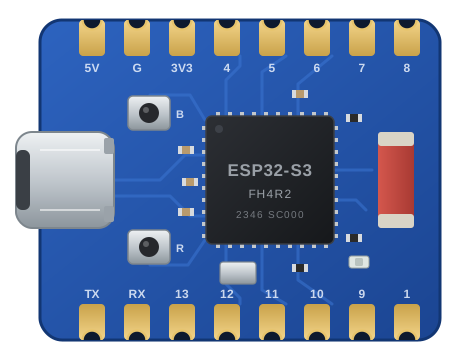
Reach your LAN with a $5 board

Home labs and office racks are not on the internet, and should not be. A bridge is an ESP32-S3 you flash from this browser and plug into any USB power on that network. It dials out to SSH Guru, so nothing is opened inbound: no VPN, no port forwarding, no exposed sshd.

  • Dials out, never listens. One outbound encrypted connection from the board to our relay. Your router stays closed.
  • Rules live on the board. Which subnets and ports it may dial is written over the USB cable during setup. The cloud has no way to change them; only re-plugging the cable does.
  • Only your browser can open it. Every session through a bridge is signed with a pairing secret that stays in your vault. A compromised server cannot use your board.
  • Still end to end. The SSH session runs between your browser and the server. The relay and the board carry ciphertext.
About $5–9 · ESP32-S3 Mini / Zero / SuperMini / XIAO ESP32-S3

Any ESP32-S3 works. Flashing takes a minute.

Any ESP32-S3 with a native USB-C port and 4 MB flash works. The XIAO ESP32-S3 adds PSRAM and an antenna connector, worth the extra dollar for a bridge that stays plugged in. SSH Guru flashes it from your browser in about a minute.

As an Amazon Associate we earn from qualifying purchases; other links may pay a small commission at no cost to you.

Table 2

Pricing

Free is a real plan, not a trial. Pro is for people who do this every week.

Free

$0
  • 3 saved connections
  • Encrypted vault and host-key pinning
  • Risk tiers on every proposal
  • Unlimited manual terminal
  • 30 Guru messages a day on house models
  • 1 LAN bridge board
Start free

Team

$29/month · 5 seats
  • Everything in Pro
  • Shared vaults with per-member access
  • Audit log of every approval
  • Fleet mode: one approved card across many hosts
Start Team
Appendix

Questions people ask first

Can SSH Guru log in to my servers?

No. The SSH client runs inside your browser. Our relay forwards encrypted bytes to your host and never holds a key, a password or a session. There is no path from our side into your machine.

What if I lose my vault passphrase?

Your saved keys and passwords are gone. We cannot recover them, because we never had them. Your connection list, host-key pins and history remain. You add the secrets again.

Does the model see everything in my terminal?

It sees the output of the commands it proposed, after a deterministic secret scanner has replaced tokens, passwords and keys with placeholders. Anything you type manually stays out unless you share it.

Can it reach servers on my home or office LAN?

Yes, with a bridge: a $5 ESP32-S3 board you flash from this browser. It dials out to SSH Guru, so nothing is opened inbound, and it only dials the subnets and ports you wrote to it over the USB cable. The SSH session is still end-to-end encrypted between your browser and the server; the board carries ciphertext.

Can it work through a bastion or jump host?

Yes, on Pro. The in-browser client dials the bastion and opens the inner connection through it, so the jump host never sees your credentials for the target either.

Is the ChatGPT sign-in allowed?

It uses the same device sign-in flow the Codex CLI uses, under your own subscription and your own usage limits. If that door ever closes, your own keys and the house models keep working.

Bring a problem. Keep your keys.

Start free